
By Oscar Hank Will III – Grit Magazine
Early last July, as I was motoring out to our southeast pasture to replenish the mineral boxes for the cattle, I noticed a red and black bounty hanging heavy in the mulberry trees along one stretch of hedgerow. I was on a mission, though, and didn’t pause — not even for a snack — but figured I’d pick some “one of these days.” Yet, even as I sped down the trail, I saw something, or at least I thought I saw something, that diverted my focus from the task at hand and made me circle around so that I could retrace my tracks. Then I discovered it.
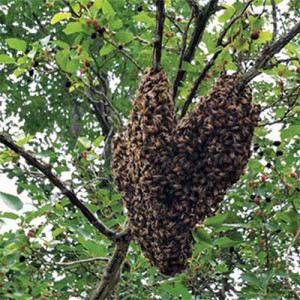
A healthy swarm of honeybees takes up residence in a mulberry tree in Osage County, Kansas. Photo by Hank Will.
About 10 feet up in one of the mulberry trees was a beautifully formed heart-shaped honeybee swarm. Wow! This was the first swarm I’d ever seen on this farm, so I stopped to observe and even climbed up on the seat of my utility vehicle to get a closer look and to snap a couple of photos. I’m always amazed at how calm these insects are when they don’t have a hive to defend — and when they’re on the move. I’m also amazed by an insect culture that can temporarily bivouac by creating a living shelter that seems to just hang from the tree. The queen tucked safely inside, is a lucky one indeed, although the future of the entire group depends on her finding the safe haven of a new hive soon.
Although it wasn’t my first thought, capturing the swarm did cross my mind — convincing a swarm such as this to take up residence in your empty hive adds real value to your orchard and garden crops, never mind the sweet reward, should the year be a good one. I might have gone after the swarm had one similar to it not chosen my only empty hive earlier in the year — through no effort of my own. In the extreme drought and heat of 2012, the bees in that hive decided to move on. And in the spring of 2013, with its abundance of wildflowers, others found it to be a good place to live.
My plan that day was to cut firewood after hauling mineral, so I was relieved to come to the conclusion that the bees would likely find a suitable hollow in one of the many trees standing in my woodlot. I was completely off the hook, sort of. I knew a few folks in my neighborhood who were still looking for bees, so I made a couple of calls and sent a couple of texts. Receiving no immediate answers, I continued on my way, marveling at the wonder of bees rather than worrying that I’d just wasted an opportunity. Kind of like resisting the urge to photograph a gorgeous sunset, rather than just take it all in. Focusing on the wonders of nature as they occur can be far more enriching than trying to capture them for later reflection.
Whether you’re watching the seasons change during your first year on the land, or you’ve recently experienced the most glorious sunrise of your life, I’d love to hear from you. And if you have any compelling tales to tell, particularly as they relate to experiences that you just can’t quite capture for later use or enjoyment, please don’t hesitate to send me a note at hwill@grit.com. It just might wind up in a future issue of the magazine.
See original article here.






2 Comments
I have a colony in my tree right now that swarmed out of my hive last year, so all winter I sprayed them with sugar water and they are still here and have produced what I call a super hive . It is massive to say the least, I also have a langstroth hive in my backyard that they originated from, so this year they have actually gotten so large that 1/3 of the bees swarmed and moved on ? I’ve checked the surrounding woods to no avail. My reason for doing so is because I’ve just built 10 flow hives and I need bees to put in them, so this week I’m going to dismantle the super hiv and put them in two separate flow hives, this should be a great experience! I’m having a friend use a GoPro to film the whole ordeal so if you would like video of the whole thing as it happens I would be more than happy to share my experience. Just give me a call @ 941-457-0777
I have a colony in my tree right now that swarmed out of my hive last year, so all winter I sprayed them with sugar water and they are still here and have produced what I call a super hive . It is massive to say the least, I also have a langstroth hive in my backyard that they originated from, so this year they have actually gotten so large that 1/3 of the bees swarmed and moved on ? I’ve checked the surrounding woods to no avail. My reason for doing so is because I’ve just built 10 flow hives and I need bees to put in them, so this week I’m going to dismantle the super hive and put them in two separate flow hives, this should be a great experience! I’m having a friend use a GoPro to film the whole ordeal so if you would like video of the whole thing as it happens I would be more than happy to share my experience. Just give me a call @ 941-457-0777