
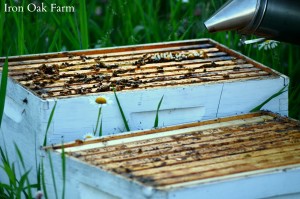
 Last night we opened the bee hive for the first inspection in three weeks.
Our goal in this inspection was to do some maintenance and to see if our queen was laying brood, and if the hive seemed to be growing.
We trimmed some of the overgrown grass around the hive entrance. The weeds have been terrible with all the rain we’ve been getting. It’s hard to stay on top of the growth!
We also sprinkled cinnamon around the base of each hive leg in an attempt to naturally control the ant population in the lid of our hive. (See more on this in my post Ants in the Hive)
Upon opening the hive we could see right away that this colony is flourishing! The bees are active and growing in number. The cells were full of honey and brood.
In fact, we were quite upset that we disturbed some brood cells when opening the hive.
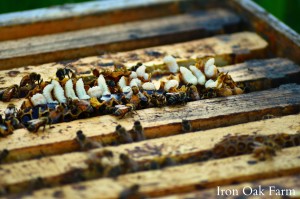 Another example of why bee keeping is a delicate balance of letting nature do its thing, and stepping in as gently as possible. The brood cells were connected to the top of the box above, so when we lifted the box, it split the cells. A reminder that it’s important to only open the hive when necessary, and with each inspection there is an element of damage to the hive.
Our harvest boxes are slightly smaller in height than the brood boxes. This is because honey can get heavy! The smaller frames make it lighter work to bring the honey into the house to be extracted.
The Queen excluder panel is placed between the top brood box and the harvest box. This allows the worker bees to make honey in these cells, but the excluder is too narrow for the queen to fit though so she can’t lay brood in these frames. This keeps the honey harvest clean, neat and brood free. You also don’t disturb any potential new bees when you take the honey off.
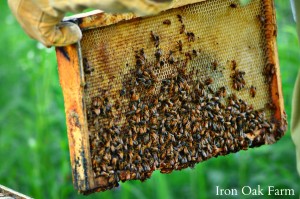 If our hive keeps up the way it is, we should expect a honey harvest in abut a month, and probably another one after that.
Managing Space in the Hive
The bees seem to work from the center outwards and the outer frames on the second brood box had barely any comb drawn, but the rest was drawn and mostly full of either brood or honey. SO they were getting close to maxing out their space. Now could be a good time to split the hive.
When to add a box?
When they seem to have drawn comb on most of the frames. Our hive already has a lot of comb filled with honey, pollen and brood.
Why not add it right away?
Intuition might tell us to give our bees a ton of space to begin with. To stack those boxes high and let them spread out. It would seem that a large hive with lots of boxes would give the colony healthy room to raise brood, make honey and prevent swarming.
However…
Bees tend to want to grow upwards. If you give them the chance they will go right to the top box, fill it up and then swarm before they get the instinct to explore any of the lower boxes. We want to control, to some extent, how they colonize the supers, so adding one box at a time as they fill the lower ones can accomplish this.
How is your honey harvest looking this year? Let us know by leaving a comment below or visit the Keeping Backyard Bees Facebook Page.






8 Comments
Still feeding hives in the Nevada desert. No blooms, pollen , or nectar yet. Sad conditions this year.
Thank you for this article! We are new beekeepers this year and this was really helpful!
My strong hive has the same condition, getting full in the 2nd deep brood box. This is my first year. I’m afraid to split this late. Not sure if they have enough time to build up each split hive before winter with pollen/nectar dearth coming. Also, there’s less chance of getting honey to harvest if they’re building up the hives again. We’ve had so much rain here in Ohio the past month so bees are building slowly
I am was drawn to this page because of the article title “Harvest Box”. I have been keeping bees for three years now and a have never heard a honey super called a harvest box. I use double deep brood boxes and have never seen a queen lay eggs above the fourth box/second honey super. I do agree that the total hive space should be controlled, but not for the reasons you stated “swarming because of too much empty space” and I am not sure why you think the queen will not move down to lay eggs. Since I am in a northern climate I am planning to follow Tim Ives and move to using 3 Deep boxes for Brood and winter storage. Thanks for the article Sam Albright
All burr comb on top of frames is drone comb, so not to worry about destroying useful brood.
Try N for the New Letter
Unbelievable nectar flow here in Maryland. Almost June and the flow is still steady and strong. Most hives 8 to 9 medium high with 4 of them brood area.
The honey flow in Central Maryland has been extraordinary. This is the best flow in the last decade. It is mow just finishing up. Cool spring but a lot of rain with warm temps have kept the clover from burning up even now.